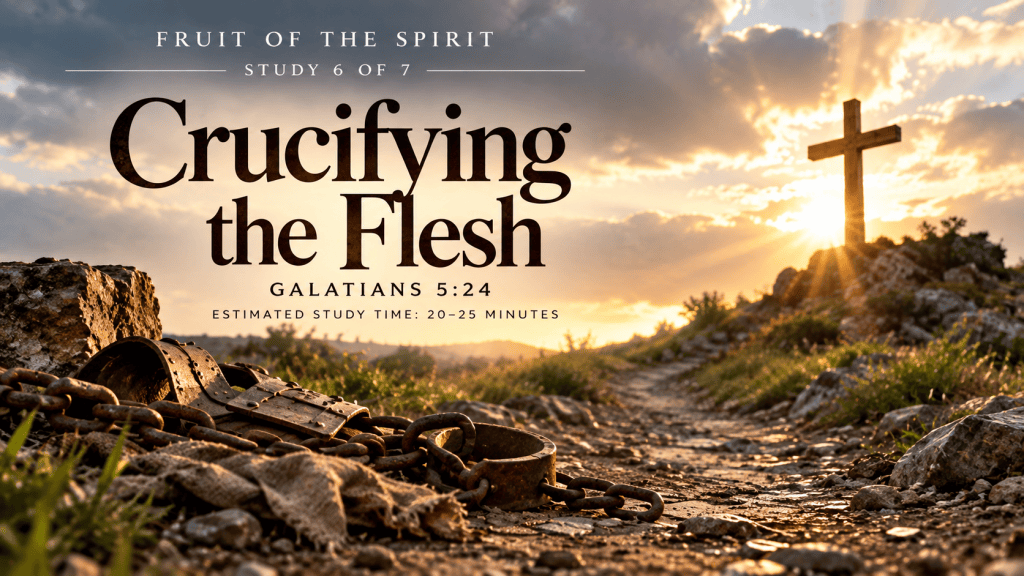
Fruit of the Spirit • Study 6 of 7
Galatians 5:24 | Estimated Study Time: 20–25 minutes
If the fruit of the Spirit is something God produces within us, what responsibility do we have for the desires and habits that continue pulling us in the opposite direction?
That question becomes important after everything Paul has said in Galatians 5. We have seen that spiritual fruit cannot simply be manufactured through determination. Love, joy, peace, longsuffering, gentleness, goodness, faith, meekness, and temperance develop as the Spirit of God works within us. Jesus’ picture of the vine and branches helped us understand that transformation begins with remaining connected to Him.
But dependence upon God does not mean that we become passive about the things in our lives that oppose His work.
Paul makes that clear in Galatians 5:24:
“And they that are Christ’s have crucified the flesh with the affections and lusts.”
The language is strong. Paul does not describe believers as people who have learned to make the flesh slightly more manageable. He uses the image of crucifixion to describe a decisive change in our relationship with it.
That does not mean Christians stop experiencing temptation or that every unhealthy desire immediately disappears. Paul has already acknowledged the conflict between the flesh and the Spirit. Something different has happened, however: the flesh no longer has an unquestioned right to determine our direction.
There is also something important in the order of Paul’s words. He begins with “they that are Christ’s.” Belonging comes before crucifying. Paul is not telling us to defeat the flesh so that Jesus will accept us. He is describing how belonging to Jesus changes the way we respond to desires that pull us away from Him.
That distinction will guide this study.
The Spirit produces the fruit, but as He works within us, there will be things we are called to surrender. Sometimes that surrender remains deeply internal. At other times, it leads to practical changes in our habits, boundaries, relationships, or choices.
So the question is not simply whether we still experience the pull of the flesh.
The more useful question is:
What are we doing with it when we recognize it?
Read the Word
Read Galatians 5:24 slowly.
“And they that are Christ’s have crucified the flesh with the affections and lusts.”
This single verse contains several ideas that are easy to move past quickly. Paul speaks about belonging to Christ, crucifying the flesh, and what the KJV calls its “affections and lusts.” Each part helps us understand what he means by surrender.
Begin with “they that are Christ’s.” Paul is describing people whose lives now belong to Jesus. That relationship changes more than what they believe; it changes what they are willing to allow to govern them.
The word flesh comes from the Greek sarx (σάρξ). The word can refer to the physical body in some passages, but that is not how Paul is using it here. Our bodies are not inherently evil. In the context of Galatians 5, Paul has been using the flesh to describe the fallen human nature with desires that operate contrary to God. Earlier in the chapter, he described the conflict plainly: “the flesh lusteth against the Spirit, and the Spirit against the flesh.”
Paul now says that those who belong to Christ have “crucified the flesh.” The Greek verb is stauroō (σταυρόω), the ordinary word for crucifying. His original readers would not have heard this as mild language. Crucifixion represented death, not improvement or rehabilitation.
Paul’s point is not that every desire of the flesh immediately disappears when someone comes to Christ. The conflict he has already described tells us otherwise. Instead, the image communicates a decisive change in authority. We are no longer supposed to treat the flesh as something that has an automatic right to be obeyed.
The final phrase takes the thought beneath outward behavior: “with the affections and lusts.”
The word translated affections is pathēma (πάθημα), which in this context refers to passions associated with the flesh. Lusts translates epithymia (ἐπιθυμία), a word meaning desire or craving. In modern English, lust is usually associated almost exclusively with sexual desire, but the Greek word is broader. Context determines what kind of desire is being described, and here Paul is speaking about desires that belong to the flesh.
That matters because Paul is not dealing only with sinful actions after they occur. He is directing our attention toward the desires that can eventually produce those actions.
Anger can be fed before it becomes an outburst. Resentment can be rehearsed long before it affects a relationship. Pride can grow quietly before anyone else recognizes it. Temptation can be entertained internally before it becomes an outward choice.
Galatians 5:24 asks us to consider what happens earlier in that process.
If we belong to Christ, what place are we giving the desires that pull us away from Him?
Crucifying the Flesh
Paul’s use of crucifixion tells us that our response to the flesh is meant to be intentional. We do not simply recognize an unhealthy desire and hope that it eventually loses its influence. There are times when following Jesus requires us to deliberately refuse something that still appeals to us.
That can be difficult because the desires of the flesh rarely present themselves as things we should immediately reject. They often come with reasons that make them seem understandable. Anger may feel justified because someone genuinely hurt us. Resentment may seem reasonable because an apology never came. Pride may disguise itself as confidence. A temptation may seem harmless because we believe we can control how far it goes.
This is where Paul’s language becomes useful. Crucifying the flesh means that we stop treating every desire we experience as something that deserves to be satisfied.
A desire can be strong without being right. An emotion can be understandable without being trustworthy enough to direct our response. Something can appeal to us while still leading us away from the kind of life the Spirit is producing.
Learning that distinction is part of spiritual maturity.
Sometimes surrender happens internally. We recognize resentment and choose not to keep rehearsing the offense. We notice envy and refuse to allow another person’s success to become a reason for bitterness. We recognize pride in our unwillingness to admit that we were wrong and decide to make the apology we have been avoiding.
At other times, surrender requires a practical change. If something repeatedly provides an opportunity for temptation, removing that opportunity may be wiser than continually placing ourselves in the same situation and expecting a different result. A habit may need to change. Access to something may need to be limited. A boundary may need to be established. We may need accountability from someone we trust.
Those actions do not produce the fruit of the Spirit by themselves, nor do they earn God’s grace. They are ways of responding to what God has already brought to our attention.
This also helps us distinguish between struggling with the flesh and protecting it.
A person can genuinely want freedom from something and still struggle. Long-established habits and desires do not always disappear because we made one sincere decision. There may be failures along the way, followed by repentance and another decision to move in the right direction.
Protecting the flesh is different. We protect it when we continually excuse what we know is wrong, arrange our lives so that it remains easily available, or defend it whenever God brings it to our attention.
Paul’s language does not require us to pretend that the struggle is easy.
It does ask us to decide which side of that struggle we intend to keep feeding.
When Surrender Becomes Practical
It is possible to talk about surrender in ways that remain entirely internal. We recognize something that needs to change, pray about it, and sincerely ask God for help. Those responses matter, but there are times when surrender also requires us to change the circumstances that keep strengthening the struggle.
If certain conversations regularly turn into gossip, for example, we may need to stop participating rather than continually asking God to help us control what we say while remaining in the same conversations. If particular content repeatedly feeds lust or unhealthy desires, removing access to it may be part of taking Paul’s words seriously. If anger repeatedly damages our relationships, repentance may involve more than regretting what we said afterward. We may need to recognize the situations in which anger begins building and learn to respond differently before it reaches that point.
The same principle can apply in less obvious areas. Pride may require us to make an apology without explaining why the other person was also wrong. Envy may require us to stop dwelling on what someone else has and begin examining why their success troubles us. Uncontrolled spending may require practical limits rather than another promise to be more careful next time.
None of these actions should be confused with trying to earn God’s favor through better behavior. They are responses to a relationship that already exists. Paul begins with people who “are Christ’s.” Because we belong to Jesus, we become willing to make changes when something in our lives repeatedly pulls us away from Him.
This is also where the previous study about abiding becomes important. Remaining connected to Jesus does not mean waiting passively for every temptation to disappear. As we spend time with Him, His Word and Spirit can expose things we have learned to overlook or justify. Once we recognize them, continuing to abide in Him includes responding to what He has shown us.
Sometimes the response will be prayer and continued patience while God works on something deeply rooted within us. At other times, the next step may be surprisingly practical.
We may already know which door needs to be closed.
The question is whether we are willing to close it.
Grace and the Struggle With the Flesh
Taking Paul’s language seriously can create another problem if we are not careful. We may begin to think that struggling with the flesh means we have somehow failed to belong to Christ. Then every temptation, wrong response, or repeated weakness becomes evidence that our relationship with God must not be real.
That is not what Paul has been teaching.
Earlier in the chapter, he openly described a conflict between the flesh and the Spirit. The fact that there is a conflict means that believers can still experience desires that do not agree with the direction God is leading them. Galatians 5:24 is not telling us that those desires will never appear again. It is telling us that our relationship with them has changed.
This is where grace becomes especially important.
Grace does not require us to pretend that sin is harmless, and it does not ask us to rename something God is confronting in our lives. At the same time, grace means that recognizing an unfinished or broken place in ourselves does not require us to hide from God until we have repaired it.
We can bring the struggle to Him honestly.
When we fail, repentance allows us to agree with God about what happened rather than excuse it. We can receive His forgiveness, learn from what exposed the weakness, and continue making the changes necessary to stop giving that area authority over us.
There is a significant difference between that response and simply becoming comfortable with the struggle.
A person who repeatedly falls while genuinely resisting something may need patience, accountability, stronger boundaries, and continued dependence upon God. The answer is not to conclude that change is impossible. Neither is the answer to pretend that the problem does not matter. Growth sometimes involves returning to the same area repeatedly until new patterns begin replacing old ones.
This is one reason shame can be so destructive. Shame can make us want to hide the very places that most need to be brought into our relationship with God. We may withdraw from prayer because we failed, avoid Scripture because we do not want to be confronted, or distance ourselves from people who could help us because we are embarrassed by the struggle.
But hiding does not weaken the flesh.
Honesty gives us somewhere to begin.
Crucifying the flesh is not about developing hatred for ourselves. It is about refusing to give something opposed to God permanent authority simply because it has been part of us for a long time.
We can acknowledge the struggle without surrendering to it.
And we can acknowledge failure without allowing failure to decide the direction in which we continue walking.
Examining What We Are Feeding
Paul’s words give us a useful way to examine our struggles before they become visible actions. Instead of looking only at what went wrong afterward, we can begin paying attention to what has been strengthening the desire beforehand.
Most patterns do not grow without being fed in some way.
Resentment can be strengthened each time we replay an offense and imagine what we wish we had said. Envy can grow when we continually compare our lives with someone else’s. Anger can become easier to justify when we repeatedly rehearse the reasons we believe we have a right to be angry. Temptation can become more difficult to resist when we continue placing ourselves near the things that awaken it.
This does not mean every temptation is something we deliberately created. We cannot always control what enters our thoughts, what circumstances we encounter, or what desires initially surface. But we can begin paying attention to what we do after they appear.
Do we redirect our attention, or continue entertaining the thought? Do we bring the struggle honestly to God, or begin looking for reasons to justify it? Do we create distance from something that repeatedly weakens us, or keep returning to it while hoping that next time will somehow be different?
These questions can help us move beyond simply regretting our failures and begin understanding the patterns surrounding them.
There may also be things we have been asking God to remove while continuing to provide them with room to grow. We may sincerely pray for greater self-control while keeping easy access to the source of a recurring temptation. We may ask God to remove bitterness while continuing to rehearse the offense. We may pray for contentment while spending much of our attention comparing what we have with what someone else possesses.
Recognizing those contradictions is not an invitation to condemnation. It gives us an opportunity to respond differently.
Sometimes the most important question is not “Why do I keep struggling with this?” but “What am I doing that continues to strengthen this struggle?”
The answer may reveal a practical change that needs to be made. It may also reveal an attitude or desire that we have never completely surrendered.
Either way, honest examination gives us the opportunity to stop nourishing what we are asking God to help us overcome.
Take Time to Reflect
Read Galatians 5:24 again and allow the verse to become personal. Paul is not asking us to search for evidence of the flesh in someone else’s life. His words invite us to consider what we are allowing to remain active in our own.
Think about the patterns surrounding the areas where you struggle. There may be a desire that appears repeatedly, a response you continue regretting, or something you have known for some time needs to change. Instead of concentrating only on the moments when you fail, consider what happens before those moments and what may be giving the struggle room to grow.
Ask yourself:
- Is there a desire, attitude, habit, or pattern that I have been managing rather than surrendering?
- Is there something I regularly ask God to help me overcome while continuing to feed it?
- What circumstances tend to strengthen this struggle?
- Have I been excusing something by treating it as simply part of my personality?
- Is there a practical boundary or change that would make it harder for this pattern to continue?
- When I fail, do I honestly bring it back to God, or do shame and embarrassment cause me to hide?
- What would surrender look like in this particular area of my life?
You do not need to search for every weakness at once. There is value in paying attention to the area God is already bringing to your attention.
Perhaps the next step is removing access to something. It may be changing a routine, asking someone you trust for accountability, making an apology, forgiving an offense you have continued rehearsing, or simply becoming honest with God about a desire you have spent a long time defending.
Whatever the issue may be, remember where Paul began:
“They that are Christ’s…”
Surrender does not begin with trying to convince Jesus to accept you. It begins from the reality that your life belongs to Him.
That relationship gives us a reason to take the struggle seriously without allowing the struggle to become the definition of who we are.
Carry It With You
Galatians 5:24 gives us a necessary balance in understanding spiritual growth. The fruit of the Spirit is God’s work within us, but His work does not make our choices unimportant. As He reveals desires, habits, and attitudes that pull us in another direction, we have a responsibility to respond.
Sometimes that response will require a clear decision. At other times, it will involve a longer process of learning new patterns, establishing boundaries, and repeatedly bringing the same struggle back to God. The presence of a struggle does not mean that surrender is meaningless. What matters is whether we are continuing to resist what pulls us away from God or gradually making room for it again.
This also changes the way we think about failure. A wrong choice does not have to become permission to abandon the direction we have been walking. We can acknowledge what happened, repent, consider what contributed to it, and make whatever changes will help us respond differently the next time.
Over time, we may discover that something which once seemed to have complete control no longer carries the same authority. The temptation may still appear, but our response to it has changed. An old attitude may surface, but we recognize it sooner. A habit that once seemed impossible to interrupt may begin losing its place in our lives.
That kind of change is worth noticing.
Paul does not tell us to become preoccupied with the flesh. His larger purpose throughout Galatians 5 is to teach us how to live according to the Spirit. Crucifying the flesh is part of that movement. We stop giving our old desires unquestioned authority so that our lives can increasingly follow the direction God is leading us.
This prepares us for Paul’s next words:
“If we live in the Spirit, let us also walk in the Spirit.”
The Christian life continues beyond the moment of surrender. There is still a direction to follow and another step to take.
As you move into the final study, carry this question with you:
Is there anything I am continuing to feed that God is asking me to surrender?
Next Study: Walk in the Spirit — Galatians 5:25–26

