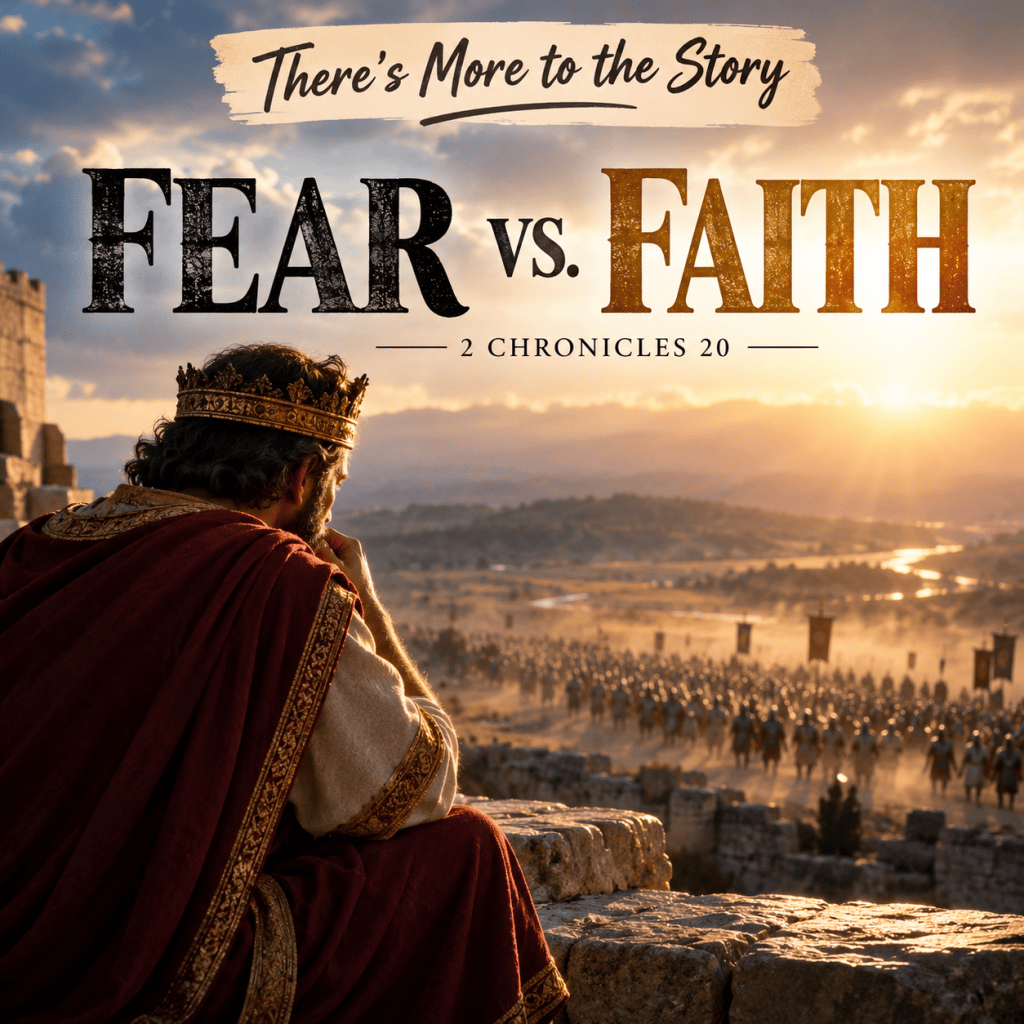
There’s More to the Story: Fear vs. Faith
We tend to talk about fear and faith as though they cannot exist in the same moment. If we are afraid, we assume our faith must be weak. If we really trust God, we tell ourselves, then surely we shouldn’t be frightened by what is happening around us.
The story of Jehoshaphat in 2 Chronicles 20 has caused me to look at that a little differently.
Jehoshaphat received the kind of news that would have frightened anyone. A great multitude was coming against Judah, and the situation was serious enough that the people bringing the report told him the enemy was already on its way. There wasn’t much time to prepare, and this wasn’t a threat that Jehoshaphat could simply ignore.
What caught my attention wasn’t that Jehoshaphat responded with some extraordinary display of confidence. Actually, the Bible tells us the opposite.
“And Jehoshaphat feared, and set himself to seek the LORD…” (2 Chronicles 20:3 KJV)
I think it is easy to read right over those first four words because we already know how the story ends. We remember the victory. We remember Judah praising God and the Lord fighting the battle for them. Knowing the ending can make us forget that the story began with a king who was afraid.
Scripture doesn’t criticize Jehoshaphat for that fear. It doesn’t hide it either. Instead, it tells us what he did with it. He was afraid, and he set himself to seek the Lord.
That small detail changes the story for me.
Maybe the difference between fear and faith isn’t always found in what we initially feel. Maybe it is found in where those feelings eventually lead us.
Jehoshaphat didn’t pretend that Judah was stronger than it was. When he stood before the people and prayed, he openly admitted how helpless their situation appeared. “We have no might against this great company that cometh against us,” he prayed. Then he admitted something that most of us have probably felt at one time or another: “neither know we what to do.”
There is something refreshingly honest about that prayer. Jehoshaphat was the king. People were looking to him for leadership, yet his prayer wasn’t filled with answers. He simply admitted that the problem was bigger than him.
Had the verse ended there, it would have been a confession of helplessness. But it didn’t.
“Neither know we what to do: but our eyes are upon thee.” (2 Chronicles 20:12 KJV)
Those final words are where faith entered the situation. Jehoshaphat still didn’t know what to do. The army hadn’t disappeared. Nothing about the circumstances had changed yet. What had changed was where he was looking.
I think there are times when we make faith much more complicated than that. We think having faith means being completely confident about what happens next. We expect ourselves to remain calm when life gives us every reason to be concerned. Sometimes we even feel guilty for being afraid, as though the emotion itself means we have somehow failed God.
But Jehoshaphat’s story gives us another picture. Sometimes faith looks like admitting that what is in front of us scares us and then turning toward God anyway. Sometimes it sounds like, “Lord, I don’t know what to do.” Sometimes there isn’t a great declaration of certainty because we genuinely don’t know how the situation is going to turn out.
We just know where to put our eyes. Life has a way of bringing us our own versions of that approaching army. A phone call can do it. A doctor’s report can do it. A financial problem, trouble in a marriage, concern for a child, uncertainty at work, or any number of unexpected circumstances can suddenly leave us staring at something we don’t know how to fix.
Our first feeling might be fear, but Jehoshaphat reminds me that the first feeling doesn’t have to determine the next decision. He was afraid before he sought God. He was still outnumbered while he prayed. He still didn’t know what to do when he turned his eyes toward the Lord. Faith didn’t require him to deny any of those things.
It required him to decide where he would look in the middle of them. Perhaps that is why the words of 2 Chronicles 20:12 have survived as such a powerful prayer. They belong not only to a king surrounded by an army thousands of years ago, but to anyone who has ever looked at a situation and genuinely had no idea what to do next.
“Neither know we what to do: but our eyes are upon thee.”
Sometimes that is faith.
Not having the answer. Not pretending there isn’t a problem. Not claiming we aren’t afraid.
Just knowing where to look.
2 Chronicles 20:1–12 KJV

